Il sistema operativo del processo di quotazione. Lo costruiamo per portare CodeZen
al NASDAQ entro maggio 2027, e mentre lo usiamo diventa la prova dimostrabile della tesi che
vendiamo al mercato.
NASDAQclosing 31 maggio 2027
10 mesi5 workstream paralleli
Blocco 1in produzione dal 20 settembre 2026
v0.131 agosto 2026
Call del 1 settembre 2026 · prima versione operativa
Accesso riservato alla console SPAC AI
La versione 0.1 è pensata per la call come prova cliccabile: non mostra una demo
generica, mostra il deal, il suo registro e i tre innesti fondamentali già esposti nella UX.
Accesso dietro gate applicativo: la pagina richiede una credenziale dedicata
prima di mostrare qualsiasi informazione del deal. Per la call basta aprire il link e incollare
la credenziale demo indicata qui sotto.
Credenziale demo dedicata alla call, valida fino all’8 settembre 2026: va incollata
una volta nel gate della piattaforma. È separata dalle credenziali operative e può
essere revocata subito dopo la call senza toccare nessun altro accesso.
CZDRData Room
Vista dedicata con documenti censiti, aggancio al percorso del deal e verifica di integrità sugli hash.
BPLBusiness Plan
Vista Snapshot & conformità: proiezioni congelate, autore, data, impronta e gate di ragionevolezza.
OUTROutreach
Vista relazioni con outbox, destinatari, canali e gate di conformità prima di ogni uscita verso l’esterno.
Prototipo per la call
Non solo deck: una prima console usabile
La schermata sotto è la versione già online: serve a far vedere il prodotto vivo,
non a raccontarlo come promessa. L'accesso resta riservato, ma il percorso di prova è immediato:
clic sul pulsante, password riservata, ingresso nella console.
Identità deal
Già usabile in lettura: società, perimetro dell'operazione, parti coinvolte e stato generale del processo.
Data room
Già visibile come indice di lavoro: documenti, versioni, evidenze e relazione con le milestone operative.
Business Plan
Già leggibile come snapshot: proiezioni congelate, data, autore, impronta e razionale di conformità.
Conformità
Già pronta come logica di controllo: valutazioni, registro prove e gate prima di ogni uscita esterna.
Il punto di partenza
Un processo reale, con vigilanza reale
Non stiamo progettando una demo. Il sistema nasce dentro un'operazione con date
contrattuali, controparti professionali e conseguenze legali.
450 M$
base di valutazione al closing, earn-out fino a 900
70 M$
PIPE fra gennaio e marzo 2027
19,2 M$
costo complessivo del processo
2,3 M$
da anticipare prima di incassare un dollaro
Cinque workstream in parallelo: legale e societario, audit e financial reporting, selezione e negoziazione SPAC, capitale, comunicazione e IR.
Almeno otto controparti esterne che devono consegnare in sequenza: securities counsel, auditor PCAOB, broker-dealer, fiscalisti, sponsor, transfer agent, IR, investitori.
Un percorso critico unico — l'audit PCAOB su struttura Italia più Dubai. Tutto il resto si comprime, quello no.
La domanda che oggi non ha risposta automatica: se l'auditor consegna
il 20 gennaio invece che il 16 dicembre, che cosa slitta, di quanto, chi va avvisato oggi e quale
clausola contrattuale si attiva. Oggi si risponde con un Excel e una call settimanale.
La narrativa
La prima quotazione eseguita da agenti AI
Una società costruita su agenti si porta in borsa usando i propri agenti. È un
posizionamento potente, e proprio per questo lo trattiamo come vincolo di progetto e non come
claim di marketing.
Come non va detto
«Una società di agenti AI si quota da sola, senza alcun intervento umano.»
Su un'operazione soggetta a vigilanza SEC un claim non verificabile non è un rischio di
reputazione: è un rischio di contestazione. E il primo che lo verifica è l'investitore
istituzionale in due diligence.
Come va detto, e dimostrato
«L'esecuzione del processo è agentica, le decisioni riservate restano umane, e il
sistema prova entrambe le cose.»
Più forte, non più debole: perché è l'unica versione che sopravvive alla due diligence,
e perché la percentuale di attività eseguite da agenti diventa un numero letto da un
registro, non una stima raccontata.
req 1Attribuzione su ogni azione
Ogni evento porta un attore tipizzato: agente, umano, o agente con approvazione umana. Nessuna scrittura anonima.
req 2Registro delle prove
Append-only e immutabile. Serve tre volte: per la narrativa, per la diligence del PIPE, per il counsel sull'S-4.
req 3Confine umano nel codice
Firme, certificazioni SEC, approvazione bilanci, prezzo e struttura: gate bloccante, non una regola scritta in un documento.
Il prodotto
Non una data room. Un motore di processo
Una data room risponde alla domanda «dove sta il documento». SPAC AI risponde alla
domanda «cosa succede adesso, a chi, e con quale conseguenza». La prima è una domanda di archivio,
la seconda è una domanda di processo.
Scadenze
Grafo delle milestone con dipendenze tipizzate e ricalcolo automatico del percorso critico.
Documenti
Versione, perimetro di riservatezza per parte esterna, marcatura dell'informazione privilegiata.
Persone
Ogni obbligo ha un responsabile con nome e cognome. Un obbligo senza nome è un difetto di configurazione.
Prove
Cosa è stato fatto, quando, da chi — agente o umano. Il registro che regge la narrativa e la diligence.
Il sistema si costruisce mentre il processo di quotazione cammina.
È esattamente la dimostrazione che vogliamo poter raccontare.
Architettura
Quattro pezzi già vivi, non quattro da inventare
SPAC AI non nasce da zero. Quattro prodotti CodeZen già in esercizio vengono
adattati e messi in serie. È la ragione per cui il Blocco 1 è questione di settimane e non di anni.
CZDRCodeZen Data Room
Diventa lo strato documentale. Ha già cartelle, versioni, tag, riservatezza e checksum. Da aggiungere: perimetro per parte esterna, marcatura MNPI, e il legame fra documento e nodo di processo — perché qui un documento non sta solo in una cartella, sta su una scadenza.
OUTROutreach Engine
Diventa il motore di relazione per i tre flussi di capitale: pre-seed, PIPE, controparti del deal. Da aggiungere: segmentazione per tipo di controparte e il gate di conformità, perché dalla LOI in avanti una comunicazione verso investitori non è una campagna commerciale.
BPLBusiness Plan vivo
Trenta fogli in cui le celle si calcolano dai dati reali di piattaforma — utenti, MAU, MRR e ARR, costi, funnel, conto economico — e le assunzioni sono governate a mano con autore e data. È la fonte naturale delle proiezioni per pre-seed, PIPE e audit.
CZBACodeZen Buddies
Gli avatar per le call operative di aggiornamento e i Q&A con i fornitori. È il pezzo con la maturità più bassa dei quattro e non appartiene al Blocco 1: entra come interfaccia opzionale su un processo che deve già funzionare senza di lui.
Il pezzo che nessuno ha
Proiezioni con una data e un destinatario
In diligence, e a maggior ragione in un deposito S-4, la domanda non è quali sono
le proiezioni. È quali proiezioni esistevano il giorno in cui le hai consegnate a quell'investitore,
con quali assunzioni e chi le aveva fissate.
Snapshot immutabile
Assunzioni con autore e data, metriche calcolate al momento della consegna, versione del modello. Congelato e firmato nel registro delle prove.
Legame con il destinatario
Ogni consegna esterna registra quale versione è uscita e verso chi. Nessun materiale con proiezioni esce senza snapshot agganciato.
Differenza leggibile
Perché il numero è cambiato fra ottobre e gennaio: cella, valore prima, valore dopo, autore. Una riga, non una ricostruzione.
È il requisito che trasforma reasonable basis da affermazione a prova. E
sta dentro il Blocco 1 per una ragione di calendario: il primo diligence pack esce il 20 settembre,
e da lì in poi ogni consegna o è tracciata o non lo sarà mai più — la versione consegnata non è
ricostruibile a posteriori.
I workflow agentici
Nove agenti, ognuno con un guardrail
Ogni agente ha un trigger, un input, un output e un limite scritto nel codice.
Elencati nell'ordine in cui vengono costruiti.
Agente
Trigger e output
Guardrail
Percorso critico
Ogni cambio di stato o data: ricalcolo, scostamento sul closing, milestone a rischio
Non muove date obiettivo di sua iniziativa: propone
Sollecito obblighi
Obbligo in scadenza: richiesta scritta alla parte sul suo canale, con la dipendenza a valle
Passa dal gate di conformità prima di uscire
Ingestione documentale
Nuovo documento: estrazione di obblighi, date e importi, con gerarchia documentale applicata
Il documento negoziato più recente prevale, sempre
Proiezioni
Ogni consegna esterna con numeri prospettici: snapshot congelato e agganciato
Non tocca le assunzioni, le fotografa
Diligence
Richiesta di una controparte: instradamento al responsabile e tracciamento
Non risponde nel merito al posto di chi risponde
Obblighi contrattuali
Sorveglianza su tail, esclusive, condizioni: clausole in attivazione
Sola lettura, non scrive mai sul piano
Cassa di processo
Giornaliero: proiezione della cassa fino al closing e allerta sul punto di rottura
Nessuna decisione di pagamento, solo evidenza
Conformità
Ogni azione in uscita verso l'esterno: intermediario, MNPI, proiezioni, destinatario
Fail-close: nel dubbio blocca e chiede
Narrativa e registro
Settimanale: quante azioni eseguite da agenti, su quali workstream, con quale intervento umano
Solo numeri letti dal registro, mai stime
Roadmap · tecnica
Blocco 1: stretto per scelta
Il rischio più concreto di questo progetto è che costruire lo strumento sottragga
attenzione alla quotazione. La quotazione la fanno l'audit e la cassa. Quindi il Blocco 1 serve
il processo, non il roadmap di prodotto.
Dentro il Blocco 1
Modello dati del deal e delle parti; grafo delle milestone con dipendenze tipizzate e motore
di ricalcolo; obblighi con responsabile e scadenza; data room con perimetro per parte e
marcatura MNPI; registro delle prove append-only con attribuzione; accesso esterno in lettura
tracciato; snapshot immutabili del Business Plan; i primi quattro agenti più l'agente delle
proiezioni; il ciclo settimanale di stato.
Fuori, per ora
Q&A strutturato di due diligence con workflow di risposta; redazione automatica e
watermarking dinamico; reportistica avanzata per l'advisor; conduzione autonoma delle call
con avatar; multi-deal e multi-tenant per clienti terzi.
Sono tutte cose sensate. Nessuna di esse serve per il 27 settembre.
Criterio di uscita del Blocco 1: il sistema regge l'operazione reale come
unica fonte di verità del processo, con almeno tre parti esterne che ci lavorano dentro, e il
percorso critico che si aggiorna da solo.
Roadmap · processo
Il sistema segue il calendario del deal
Non un piano di prodotto con date proprie: ogni rilascio è agganciato a una
milestone della quotazione, e serve quella.
Settembre 2026
Milestone, obblighi, data room, registro
Il percorso critico vive e si aggiorna. Primo diligence pack il 20 settembre con snapshot delle proiezioni agganciato. LOI il 27 settembre.
Ottobre — Dicembre 2026
Audit e cassa sotto sorveglianza
Tracciamento delle richieste dell'auditor e monitoraggio del margine sul percorso critico. Allerta anticipata sul punto di rottura di cassa, che ha già una data: dicembre 2026.
Gennaio — Marzo 2027
S-4, PIPE, annuncio
Ogni materiale con proiezioni esce con snapshot e controllo di ragionevolezza documentato. Outreach sul PIPE dentro il perimetro regolamentato.
Aprile — Maggio 2027
Closing, e il registro come racconto
I numeri della narrativa letti dal registro: quante azioni eseguite da agenti, su quali workstream, con quale tasso di intervento umano.
Roadmap · business
Tre ritorni, tempi diversi
oggiInterno
Dieci mesi, cinque workstream, otto controparti, margine sottile. Gestirlo bene vale settimane di calendario — e qui una settimana ha un prezzo, perché tocca la cassa di processo e attiva clausole contrattuali.
2027Narrativo
Il sistema è la prova della tesi. Non diciamo che l'AI può gestire processi complessi: lo stiamo facendo su un'operazione con vigilanza, controparti professionali e conseguenze reali.
postDi prodotto
Se regge sulla nostra quotazione diventa un verticale vendibile. Mercato piccolo in numero di operazioni, disponibilità di spesa alta: su un budget di processo da diciannove milioni, il costo dello strumento è irrilevante.
Posizionamento. Non competiamo con le data room, ci
integriamo sopra di loro. Lo spazio scoperto è il processo visto dalla parte dell'emittente: gli
strumenti esistenti servono l'advisor che segue molte operazioni, non la società che ne affronta
una sola e decisiva. Il differenziale più difficile da replicare è il Business Plan vivo — nessuna
data room di mercato lega le proiezioni al dato operativo che le genera, né conserva la versione
consegnata a ciascuna controparte.
auto
percorso critico aggiornato senza intervento manuale
%
obblighi consegnati entro la data prevista
%
azioni del processo eseguite da agenti
100%
consegne con proiezioni coperte da snapshot — unico valore accettabile
Chiusura
Quello che serve dalla call
Allineamento sulla narrativa nella forma difendibile: esecuzione agentica, decisioni riservate umane, il sistema che prova entrambe le cose. È la versione che regge in due diligence.
Come e quando usarla nel percorso: cosa può essere detto ora al pre-seed, cosa entra nell'annuncio di marzo, cosa resta fuori dai materiali soggetti a vigilanza.
Un canale unico verso le controparti. Auditor e studi legali non cambiano strumento per noi: partecipano dai loro canali abituali, l'interfaccia è un'opzione e non un requisito. Ma lo stato del processo deve stare in un posto solo.
Validazione del perimetro regolamentare dello strato permessi e MNPI da parte del securities counsel, prima di aprire il sistema a chiunque non sia CodeZen.
Una società di agenti che si porta in borsa usando i propri agenti.
Con il registro che lo dimostra, riga per riga.
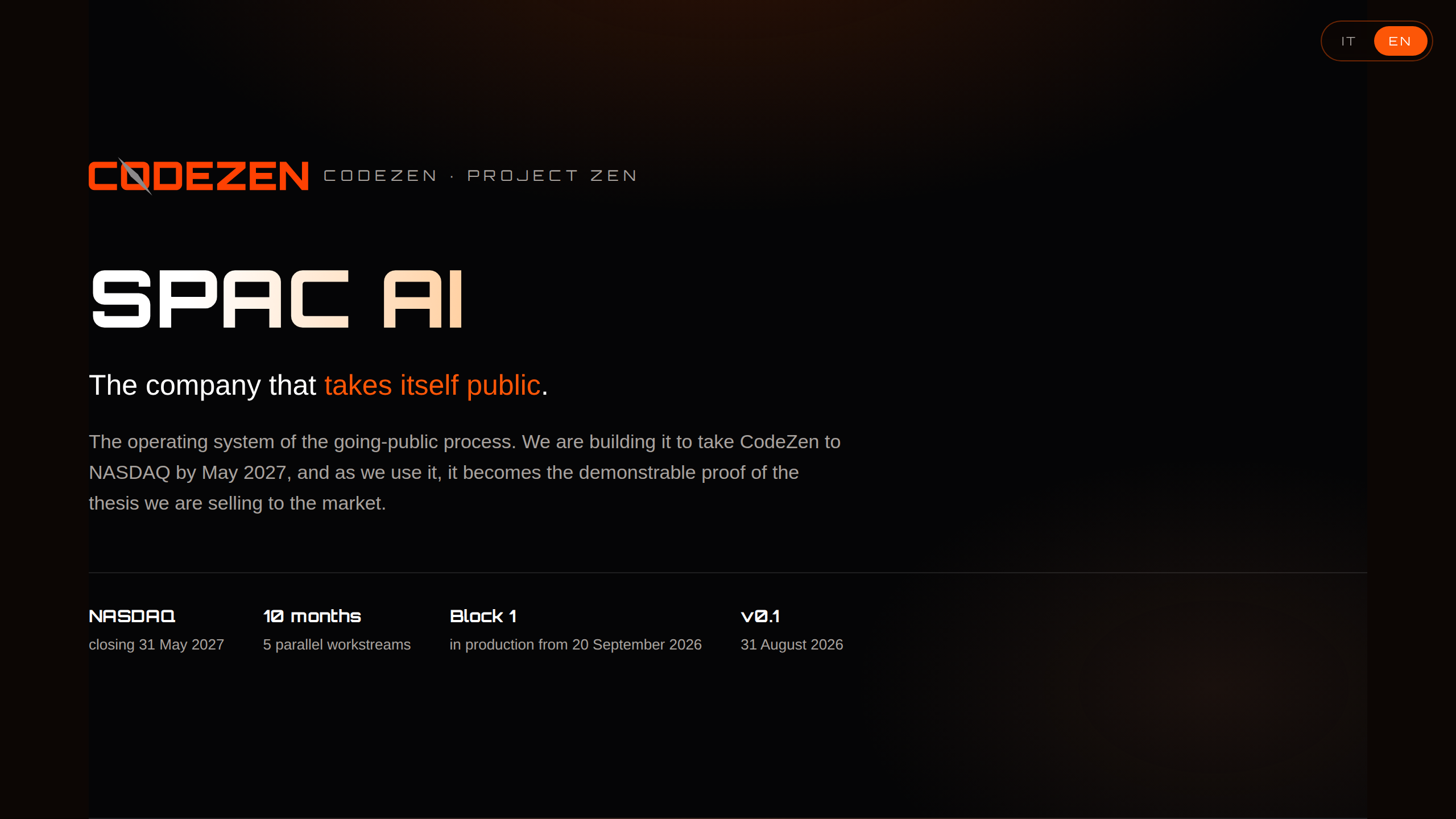
CodeZen · Project Zen
SPAC AI
The company that takes itself public.
The operating system of the going-public process. We are building it to take CodeZen
to NASDAQ by May 2027, and as we use it, it becomes the demonstrable proof of the thesis we are
selling to the market.
NASDAQclosing 31 May 2027
10 months5 parallel workstreams
Block 1in production from 20 September 2026
v0.131 August 2026
1 September 2026 call · first operational version
Restricted access to the SPAC AI console
Version 0.1 is designed for the call as clickable proof: it does not show a generic
demo, it shows the deal, its evidence ledger and the three core integrations already exposed in the UX.
Access sits behind the application gate: the page requires a dedicated
credential before showing any deal information. For the call, open the link and paste the
demo credential shown below.
Demo credential dedicated to this call, valid until 8 September 2026: paste it once
into the platform gate. It is separate from operating credentials and can be revoked
right after the call without affecting any other access.
CZDRData Room
Dedicated view with listed documents, deal-process linkage and hash integrity checks.
Relationship view with outbox, recipients, channels and compliance gate before every external touchpoint.
Prototype for the call
Not only a deck: a first usable console
The screen below is the version already online: it shows the product as a living
system, not as a promise. Access remains restricted, but the test path is immediate: click the
button, enter the restricted password, enter the console.
Deal identity
Already usable in read mode: company, transaction perimeter, parties involved and overall process state.
Data room
Already visible as a working index: documents, versions, evidence and linkage to operating milestones.
Business Plan
Already readable as a snapshot: frozen projections, date, author, fingerprint and compliance rationale.
Compliance
Already ready as control logic: assessments, evidence ledger and gate before every external release.
The starting point
A real process, under real oversight
We are not designing a demo. The system is born inside a live transaction with
contractual dates, professional counterparties and legal consequences.
$450M
valuation base at closing, earn-out up to 900
$70M
PIPE between January and March 2027
$19.2M
total cost of the process
$2.3M
to be funded before a single dollar comes in
Five parallel workstreams: legal and corporate, audit and financial reporting, SPAC selection and negotiation, capital, communication and IR.
At least eight external counterparties that must deliver in sequence: securities counsel, PCAOB auditor, broker-dealer, tax advisors, sponsor, transfer agent, IR, investors.
One single critical path — the PCAOB audit over an Italy-plus-Dubai structure. Everything else can be compressed; that cannot.
The question that today has no automatic answer: if the auditor delivers on
20 January instead of 16 December, what slips, by how much, who must be told today and which
contractual clause is triggered. Today the answer comes from a spreadsheet and a weekly call.
The narrative
The first listing executed by AI agents
A company built on agents takes itself public using its own agents. It is a powerful
positioning, and precisely for that reason we treat it as a project constraint, not as a marketing
claim.
How it must not be said
«A company of AI agents takes itself public with no human involvement whatsoever.»
In a transaction subject to SEC oversight, an unverifiable claim is not a reputational risk:
it is a litigation risk. And the first party to test it is the institutional investor in
diligence.
How it must be said, and proven
«Process execution is agentic, restricted decisions remain human, and the system proves
both.»
Stronger, not weaker: because it is the only version that survives due diligence, and because
the share of activities executed by agents becomes a number read from a ledger, not an estimate
told in a story.
req 1Attribution on every action
Every event carries a typed actor: agent, human, or agent with human approval. No anonymous writes.
req 2Evidence ledger
Append-only and immutable. It serves three purposes: the narrative, PIPE diligence, and counsel on the S-4.
req 3Human boundary in the code
Signatures, SEC certifications, approval of financial statements, price and structure: a blocking gate, not a rule written in a document.
The product
Not a data room. A process engine
A data room answers the question «where is the document». SPAC AI answers the
question «what happens next, to whom, and with what consequence». The first is an archive question,
the second is a process question.
Deadlines
A milestone graph with typed dependencies and automatic recalculation of the critical path.
Documents
Versioning, confidentiality perimeter per external party, marking of material non-public information.
People
Every obligation has an owner with a first and last name. An obligation without a name is a configuration defect.
Evidence
What was done, when, by whom — agent or human. The ledger that supports the narrative and diligence.
The system is built while the listing process moves forward.
That is exactly the demonstration we want to be able to tell.
Architecture
Four pieces already alive, not four to invent
SPAC AI does not start from zero. Four CodeZen products already in operation are
adapted and put in series. That is why Block 1 is a matter of weeks and not years.
CZDRCodeZen Data Room
Becomes the document layer. It already has folders, versions, tags, confidentiality and checksums. To be added: per-external-party perimeter, MNPI marking, and the link between a document and a process node — because here a document does not just sit in a folder, it sits on a deadline.
OUTROutreach Engine
Becomes the relationship engine for the three capital flows: pre-seed, PIPE, deal counterparties. To be added: segmentation by counterparty type and the compliance gate, because from the LOI onwards a communication to investors is not a commercial campaign.
BPLLiving Business Plan
Thirty sheets where cells are computed from real platform data — users, MAU, MRR and ARR, costs, funnel, P&L — and assumptions are governed manually with author and date. It is the natural source of projections for pre-seed, PIPE and audit.
CZBACodeZen Buddies
The avatars for operational update calls and Q&A with vendors. It is the least mature of the four and does not belong to Block 1: it enters as an optional interface on a process that must already work without it.
The piece nobody has
Projections with a date and a recipient
In diligence, and even more so in an S-4 filing, the question is not what the
projections are. It is which projections existed on the day you delivered them to that
investor, under which assumptions, and who had set them.
Immutable snapshot
Assumptions with author and date, metrics computed at delivery time, model version. Frozen and signed into the evidence ledger.
Link to the recipient
Every external delivery records which version went out and to whom. No material containing projections leaves without a snapshot attached.
Readable difference
Why the number changed between October and January: cell, value before, value after, author. One line, not a reconstruction.
This is the requirement that turns reasonable basis from a statement into
evidence. And it sits inside Block 1 for a calendar reason: the first diligence pack goes out on
20 September, and from then on every delivery is either tracked or lost forever — the delivered
version cannot be reconstructed after the fact.
Agentic workflows
Nine agents, each with a guardrail
Every agent has a trigger, an input, an output and a limit written into the code.
Listed in the order in which they are built.
Agent
Trigger and output
Guardrail
Critical path
Any status or date change: recalculation, deviation against closing, milestones at risk
Never moves target dates on its own: it proposes
Obligation chasing
Obligation coming due: written request to the party on its own channel, with the downstream dependency
Goes through the compliance gate before going out
Document ingestion
New document: extraction of obligations, dates and amounts, with document hierarchy applied
The most recent negotiated document always prevails
Projections
Every external delivery containing forward-looking numbers: frozen snapshot, attached
Never touches assumptions, it photographs them
Diligence
Counterparty request: routing to the owner and tracking
Never answers on the merits in place of the owner
Contractual obligations
Monitoring of tails, exclusivities, conditions: clauses about to trigger
Read-only, never writes on the plan
Process cash
Daily: cash projection through closing and alert on the breaking point
No payment decisions, evidence only
Compliance
Every outbound action to the outside world: intermediary, MNPI, projections, recipient
Fail-close: when in doubt it blocks and asks
Narrative and ledger
Weekly: how many actions executed by agents, on which workstreams, with what human involvement
Only numbers read from the ledger, never estimates
Roadmap · technical
Block 1: narrow by design
The most concrete risk of this project is that building the tool takes attention away
from the listing. The listing is made by the audit and by cash. So Block 1 serves the process, not
the product roadmap.
Inside Block 1
Data model of the deal and the parties; milestone graph with typed dependencies and a
recalculation engine; obligations with owner and due date; data room with per-party perimeter
and MNPI marking; append-only evidence ledger with attribution; tracked external read access;
immutable Business Plan snapshots; the first four agents plus the projections agent; the weekly
status cycle.
Out, for now
Structured due diligence Q&A with response workflow; automated redaction and dynamic
watermarking; advanced reporting for the advisor; autonomous call handling with avatars;
multi-deal and multi-tenant for third-party clients.
All of them make sense. None of them is needed for 27 September.
Block 1 exit criterion: the system holds the real transaction as the single
source of truth of the process, with at least three external parties working inside it, and a
critical path that updates itself.
Roadmap · process
The system follows the deal calendar
Not a product plan with dates of its own: every release is tied to a listing
milestone, and serves it.
September 2026
Milestones, obligations, data room, ledger
The critical path is live and self-updating. First diligence pack on 20 September with the projections snapshot attached. LOI on 27 September.
October — December 2026
Audit and cash under watch
Tracking of auditor requests and monitoring of the margin on the critical path. Early alert on the cash breaking point, which already has a date: December 2026.
January — March 2027
S-4, PIPE, announcement
Every material containing projections goes out with a snapshot and a documented reasonableness check. PIPE outreach inside the regulated perimeter.
April — May 2027
Closing, and the ledger as the story
The numbers of the narrative read from the ledger: how many actions executed by agents, on which workstreams, at what rate of human intervention.
Roadmap · business
Three returns, on different horizons
todayInternal
Ten months, five workstreams, eight counterparties, a thin margin. Running it well is worth weeks of calendar — and here a week has a price, because it hits process cash and triggers contractual clauses.
2027Narrative
The system is the proof of the thesis. We are not saying that AI can run complex processes: we are doing it on a transaction with regulatory oversight, professional counterparties and real consequences.
postProduct
If it holds on our own listing it becomes a sellable vertical. A small market in number of transactions, with high willingness to spend: on a nineteen-million process budget, the cost of the tool is irrelevant.
Positioning. We do not compete with data rooms, we
integrate on top of them. The uncovered space is the process seen from the issuer's side: existing
tools serve the advisor who follows many transactions, not the company facing one single decisive
deal. The hardest differentiator to replicate is the living Business Plan — no data room on the
market links projections to the operating data that generates them, nor preserves the version
delivered to each counterparty.
auto
critical path updated with no manual intervention
%
obligations delivered by the due date
%
process actions executed by agents
100%
deliveries with projections covered by a snapshot — the only acceptable value
Closing
What we need from the call
Alignment on the narrative in its defensible form: agentic execution, restricted decisions human, the system proving both. It is the version that holds in due diligence.
How and when to use it along the path: what can be said now to pre-seed investors, what goes into the March announcement, what stays out of materials subject to oversight.
A single channel towards counterparties. Auditors and law firms will not change tools for us: they take part from their usual channels, the interface is an option and not a requirement. But the state of the process must live in one place only.
Validation of the regulatory perimeter of the permissions and MNPI layer by securities counsel, before opening the system to anyone outside CodeZen.
A company of agents taking itself public using its own agents.
With the ledger that proves it, line by line.
 CodeZen · Project Zen